Monday, April 21, 2008

Wednesday April 9t

Conventional current is the flow of positive charge. The charge flows from postive to Negative. However, in reality electrons are being flowing in the oppositive direction. Electronn current is when electrons (or the negative charge) are flowing from positive to negative. The Right Hand Rule is important because it shows the direction of the magnetic field aoudn a current carrying conductor. By putting your thumb upright, is shows the currents direction. The direction that the fingers curl show the direction of the magnetic field. The concentric cirlces of the magnetic field aorund a current carrying wire can be labeled with dots or crosses. Solenoids is the wire wound as a helix around a metallic core. When an electrical current is passed through it, it creates a magnetic field. A bar magnet is similiar to the field shape of a solenoid madnetic field. The field can increase with greater current, more turns of wire, and soft iron core. When using the right hand rule for a solenoid, the thumb must point to the north pole.

Wednesday, April 2, 2008

Wimshurst Machine


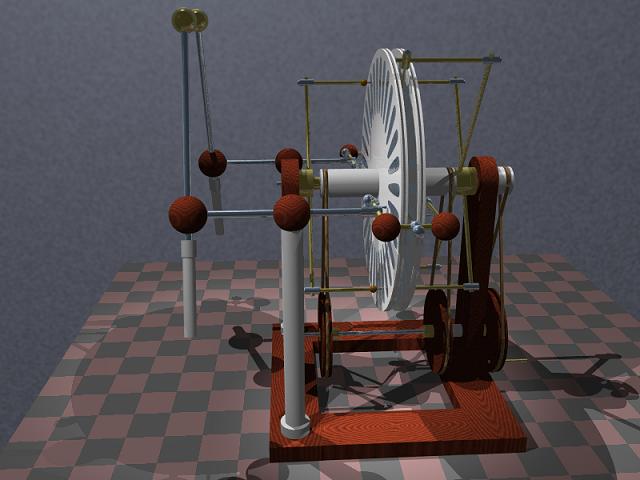
This machine creates electric charges through electrostatic induction and is used to generate high voltages. It was develeped between 1880 and 1883 by a British inventor by the name of James Wimshurst. This machine consists of two insulated disks and their metal sectors which rotate in opposite directions. This movement creates an imbalance of charges which is amplified and collected by two pairs of metal combs. These combs have points placed near the surfaces of each disk and are mounted on insulated supports. These are then connected to the output terminals. If everything goes as planned you will see a spark jump across the gap.


Tuesday, April 1, 2008

Tuesday April 1st

Today we started out the day by going over our homework from last night. (it was that packet with all the different circuits) A few things to remember is to watch out for when it is K-ohms. It is a good review, definately worth doing if you haven't already. We then started with notes. It was pretty much a review of yesterdays lesson. See Pauls post if you missed Monday! We worked on a practice worksheet as well. It was helpful because it helped to reinforce and actually see these rules applied. A few things to note when drawing circuits. Be careful as to where you place the Ammeter. Be sure to place it where you get the full currect and not between where the current may be split. You can use your reference table to help you with the signs that need to be used. Also another thing from the Practice Worksheet always look at the different options you have to equations.
We also learned about meters in circuits.
A voltmeter: It is connected in a parallel circuit and it is intended to measure potential difference between two positions in a circuit. It has an extremely high internal resistance which means it won't let much current through.
A Ammeter: It measures current through a single point in a circuit. It has an extremely low internal resistance which creates an extremely small voltage drop.
There was no homework assigned today. There is a test Monday, I suggest doing the review packets.

Monday, March 31, 2008


Today we analyzed circuits, learning primarily about equivalent resistance, which is always measured from the source. The equation is R=V/I. There are two primary types of circuits, series and parallel. Series circuits have only one path for the current to travel, with many drops of potential along the way. Here is picture of a series circuit:


The current in a series circuit is the same throughout, and the sum of the potential drops is equal to the source potential. In this type of circuit, resistance is measured as the sum of the resistance of its components. On the other hand, parallel circuits have only one potential drop because there are multiple paths for the current to flow. In this case, total current is measured by the sum of the branch currents, which is equal to the current supplied by the source. Here is a picture of a parallel circuit:


As in a series circuit, resistance in a parallel circuit is measured as the sum of the resistance of its branch resistors, however the reciprocal must be taken in this case. That just about wraps up today’s lesson, peace.

Sunday, March 30, 2008

3/26


Today we learned about circuits and currents.


We learned the difference between an alternating current and direct current which is self explanitory by the name


We learned what a current was, the flow of electric charge, and that the symbol was I. The unit of charge is an Ampere or Amp.


Resistance is the opposition to current flow and is represented by the symbol R. Its unit is the Ohm.


Ohm's Law-At constant temperature, the current in a metallic conductor is directly proportional to the potential difference between its ends.


Ohm's law has a few equations such as R=V/I, I=V/R, and V=IR


Friday, March 28, 2008

3/28/08 Circuits Blog


Equivalent Resistance = V/I

Ohm's Law applies to the circuit as a whole, and to each individual resistor. We can build circuits in several different configurations. The current flow can branch out and back in.


Wednesday, March 26, 2008

Tuesday, March 25, 2008


Today we started off writing sentences that accuratley incorporate the word circuit. We then went to notes where we learned about circuits. An electrical circuit is a closed loop or path through which charged particles can travel through. A closed electrical circuit allows for an electrical current to form. An electrical current is formed by a source of potential differences and includes one or more resistances.
We then learned about how water is analagous to electrical flow. We also watched a video on electrical flow. This video mentioned how the invention of the battery revolutionized technology and eventually led to Thomas Edison to develop electricity lamp.
Then we learned about circuit elements. Circuit elements include:
Source elements, which produce a potential difference
Load elements, which is a device that the source is connected to
Control elements, that controls the flow of electric current such as a switch
We also learned some new terms such as Current (I) which is the flow of electric charges. It is also the time-rate at which charge flows past a given point in a circuit. We found out that other electrical terms and equations are in our reference tables. The equation I= the change in charge (q)/ time(t).

Thursday, March 13, 2008

Question #63

The Wimshurst Machine

The Leyden Jar
A leyden jar is a 1746 device that is still very known today. It was first created by the Dutch physicist Pieter van Musschenbroek of the University of Leyden and Ewald Georg von Kliest of Pomerania, working separately. However, today, most of the credit of the device is given to Pieter.
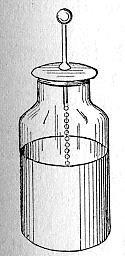
A leyden jar is made up of a glass jar with an outer and inner coating of metal which covers the bottom and sides of the jar almost up as far as the neck. Sealing the jar is a wooden stopper with a brass rod through the center of it. This brass rod has a ball at the external end of it and connects internally with the metal coating through a loose chain. This is shown in the picture above. When a charge is applied to the knob at the end of the rod, positive and negative charges emerge from the metal coating on either side of the jar. However, they are not able to discharge because of the glass between them. This means that there are two conductors (the metal covering) which are separated by an insulator (glass). As a result, the positive and negative charges hold themselves together in equilibrium until a grounding force is applied. This results in a storage of electricity. To use this electricity, the two conductors must be somehow connected, either with a wire which would allow the use of this electricity, or with a hand which could result in a serious shock. It was the very first capacitor.
The Wimshurst Machine was created by an Englishman named James Wimshurst who was part of the shipping business for the British Board of Trade. Today, however, he is known for his work in improving the Voss’ electrostatic generator. He changed the design so that the disks of the machine contra-rotate. The metal foil portions on the disks induce charges on each other which can be taken off by small, metal brushes and stored within the Leyden jars mentions above. The Wimshurst machine works through the quantum effect in that when two different conducting metals touch each other, a small current is transferred between them because of the different number of electrons in their atoms. This is able to occur on this machine when the sectors in the disk pass through one of the charge neutralizers. Once this occurs, the sector becomes charged and when it passes by a sector on the other side of the disk, it results in an equal and opposite charge on that sector. The front disk has one charge and as it spins, it begins to create a negative charge on the other side of the disk. This also occurs with the lower part of the disks but reverse. Therefore, when the sector passes by the neutralizer bar, it becomes neutral and is ready to be charged again. As a result, there are low and opposite charges on the top and bottom and high and equal charges on the sides. The high charges are then transferred over to the layden jars attached to the machine which are then connected to the discharge terminals. After the voltage builds up, a spark occurs across the terminals and the cycle begins over again. The entire process is demonstrated in the clip listed below:
http://www.wimshurstmachine.com/

Sources:

Question #63

Throughout history there have been many early sources that helped us study static electricity. One of the most earliest sources was the leyden jar. The main idea behind the leyden jar was the concept was to store electrical energy, most likely between two conductors. This device was invented by the brilliant Pieter van Musschenbroek in the year of 1745. It later became credited as the first capacitor, but was first referred to as a condenser. After energy was stored, it could be used to charge something. A leyden jar would have looked like the following.


Another notable invention was the Wimshurst Machine. This was a device that was created by James Wimshurst. It was invented around the year 1880. Unlike the other device, this one was used to generate electricity, not store it. It would later be referred to as an electrostatic generator. It was designed to have two roatating discs which allowed a current of electrons to be transferred between. Both of these inventions were notable in the field of electricity.

The Wimshurst Machine was developed between 1880 and 1883 by James Wimshurts. It is an electrostatic device created for the purpose of generating high voltages. It has two contra-rotating discs on a vertical spine with two cross bars, metallic brushes, and a spark gap. It is an influence machine because it creates electric charges through electrostatic induction. It is self-starting but does need mechanical power initially to rotate the disks. The current produced is constant and proportional to the size of the metals disks and the rate at which they are rotating. The Leyden Jar is an early storage device for electric charge. It was the first capacitor. The original form of the device was just a glass bottle partially filled with water, with a metal wire passing through a cork closing it. Soon it was found that it was better to coat the exterior of the jar with metal foil, leaving the impure water inside acting as a conductor. Franklin invented his electric bells in the middle of the 18th century when noticed that a pith ball or cork would initially be attracted to a charged object, but if the two touched the ball would be repelled. He realized that this was because the two objects were initially charged differently but once they touched they took on the same charge. Franklin realized that if he replaced the charged object with a bell, he could make an "electric bell." He soon found practical use for his bell as a lightning detector. When connected it to his lightning rod, the bell would ring whenever an electrical storm was nearby.

Wednesday, March 12, 2008

Chapter 20: Question #63

Katie Shill
12 March 2008

Numerous research devices were used in the 17th and 18th centuries to study static electricity, including the Leyden jar and the Wimshurst machine. First, the Leyden jar was invented in 1745 by a man named Pieter van Musschenbroek. The Leyden jar was the first capacitor. A capacitor is an electronic device that can store energy in the electric field between a pair of conductors. The process of storing energy in the capacitor is known as "charging", and involves electric charges of equal magnitude, but opposite polarity, building up on each plate.
A battery of four Leyden jars:

Another invention used during this time period was Wimshurst machine. The Wimshurst machine is an electrostatic device for generating high voltages. It has a distinctive appearance with two large rotating discs mounted in a vertical plane, two cross bars with metallic brushes, and a spark gap formed by two metal spheres.
A Wimshurst machine with two Leyden jars:

Works Cited
chem.ch.huji.ac.il/instruments/archaic/leyden_jars.htm
www.wikipedia.org/

Question #63


The leyden jar was an early device created for storing charge. It was invented in 1745 by Peter van Musschenbroek. It was the first capacitor ever invented and was used in many early electricle experiments. The creation of this device pathed the way for further progresses in electricity and its storage.
The leyden jar worked by having an electrode connected to a foil inside of a jar. A conducting foil was rapped around the outside of the jar. Or the inside of the jar was partially filled with water. The water at first was used as a conducter, later they found that foil works better to collect the charge. The process was powered by an electrostatic generorator. The charge is stored in the glass of the leyden jar. The thinner the dielectric and the closer the plates were to each other increased the capacity at a certain voltage. It has later been found that the dielectrics were not neccesarry but just increased the capacity and prevented arcing between the plates.

The leyden jar was a break through in the storage of electricity. This discovery eventually led to the modern capacitor.

Tuesday, March 11, 2008

Today in class we talked about action at a distance.  The electrostatic force is an example of action at a distance.  Non contact forces are action at a distance forces.  Gravity is another example of action at a distance forces.  A diagram was given of an electroscope.  A charged balloon was moved toward the electroscope and it acted on the electroscope at a distance.  Action at a distance forces are also known as field forces.  An electric charge creates an electric field.  This field alters the space around it.  The magnitude of electric field strength is equal to force per unit changed.  The direction of the force exerted on a positive test charge.  The electric field is made up of a single point charge; either positive or negative, a charged conducting sphere, or two point charges; both either negative or positive, and a pair of charged parallel plates.  The point charge equals all charge concentrated at a point.  A charged conducting sphere acts as though all the charge were concentrated at the center.  A field within a charged conducting sphere is zero.  The same principle is used in the faraday cage.  A diagram of a pair of positive point charges, a pair of negative point charges, and one point charge that is negative and one that is positive.  The electromagnetic field always runs in through the negative point charge and out through the positive point charge.  A diagram of charged parallel plates was shown.  The top plate was positively charged and the bottom plate was negatively charged.  The field was moving in a downward fashion, from the positive to the negative.  The intensity of electric field varies inversely with the square of the distance from the point charge.  The greater intensity seen by greater concentration of field lines.  Two diagrams showed how more lines indicated stronger electric fields and the way the way the field lines were when objects had unequal charges. 

Chapter 20 Question 63

Static electricity has been studied for a very long time, beginning in 600 BC. People discovered that when amber was rubbed with cat fur, pieces of paper were attracted to the amber. This basic knowledge was able to help later scientists in their studies of static electricity. People experimented with electricity by using conductors, and discovered that sparks, chains, and strips could pass to these conductors which joined the conductors to insulated glass globes (Electrical Machines History). Later, in the seventeenth century, Otto Von Guericke invented a machine that produced static electricity (Artwork LDC). Inside a glass globe, Von Guerbicke placed a sulfur ball mounted on a pole. This machine was rotated by a hand crank. When it was spinning, it rubbed against a pad which then generated static electricity sparks (Artwork LDC). This machine was the first electric generator.
During the eighteenth century, machines involving static electricity improved. One of these machines was the Ramsden Friction Machine. This machine was made up of a circular piece of glass which was on an axle. The machine was turned by a handle which allowed it to rub against two pads. This caused the machine to be electrified on two sides (Electrical Machines History). When the handle turned, the glass plate was charged positively. The plate repelled positive charges to the ends of the conductors and left parts of them with a negative charge (Electrical Machines History). Friction allowed the glass to be continuously positively re-electrified.
In 1772, a scientist by the name of LeRoy invented a machine that included two insulated cyllindric conductors that were placed horizontally. These conductors collected both positive and negative charges. One of the conductors was positively charged while the other was negatively charged (Electrical Machines History). Van Marum created another machine which was similar to Ramsden's. The object of the machine was to collect positive and negative charges (Electrical Machines History).

Works Cited:

Artwork LDC. Ottoman Von Guericke 1602-1686. About.com: Inventors. 2008. 11 March 2008. >.

Electrical Machines History. Sparks Museum Early Radio and Scientific Apparatus. 11 March 2008. <
http://www.sparksmuseum.com/FRICTION_HIST.HTM>.

Kodiac1. Static Electricity. Urban Dictionary. 3 July 2006. 11 March 2006. >.


Fiber Optics Project


You hear the term fiber optics alot when people talk about telephone systems and cable tv. They have become a large part of our society helping us to become more technologically advanced. This technology helps with many things you would never expect. They are hiding in many electronics we rely on such as cable, phones, many internet providers use them, and they are used in many other electronics like surround sound. This technology provides us with a way to get information fast and makes everyday life a lot easier for everyone.
So we use fiber optic cables everday without knowing it, how does it work? The primary idea revolves around light traveling to provide fast transport of information. This occurs by taking an insulator primarily plastic or glass and using it to prevent the light energy from escaping. The light then travels through the cable which is hollowed out. The light is kept inside of the core by total internal reflection. This prevents loss of information and provides fast transport. The use of this technique causes the fiber to act as a wave guide. There are multimode fibers and single mode fibers. These are the main to kinds of fiber optic cables. The multimode fibers have more than one path for the light to travel down while the single mode fibers only have one. The multimode fibers are less common and are used for carrying large amounts of data shorter distances, they are used of often in buildings. The single mode fibers are used more often and are good for distances longer than 200 meters, these are the fibers used in phone wires.


Fiber optics are more complicated to put together than metal wires. They must be evenly cut and fitted together properly. The benefits are there though. The speed of light provides fast and large information travel possible. They have very high bandwidth which is what allows for the large amount of data travel. They also do not radiate which means no interference at all. This is relevent because when two singnals interfere their quality decreases. An example would be when you hold a cell phone next to a radio of some kind. If anyone has done this often you will get a loud noise thats extremely annoying. This makes fiber optics much better than metal wires because all electronics not using fiber optics give off radiation. This is why many orginizations such as the NSA (national security association) use fiber optics because the radiation caused by regular wire can be picked up and cause data to be stolen. Fiber optics is used for security for its unique ability to insulate and not loose any photons at all. In the end there is no reason not to use fiber optics unless you dont need the speed or the capacity otherwise it is the future and will continue to provide some of the best data transportation.

The principle behind light guiding used in fiber optics was first displayed by Daniel Colladon and Jaques Babinet in 1840. John Biard helped to pioneer the idea in the 1920's he was a television pioneer. The pricnicples set by these men helped usher in the idea of fiber optics. In 1970 the Corning Co. created a fiber optic cable made of glass that made long distance use possible. The use of this new technology allowed for the creation of the internet.


Fiber optics have a huge effect on our lives each day without them many of the conveniences we take for granted would not be possible.

Question #63

There were many different devices used in the 17th and 18th century to study static electricity. One of the main ones was the Leyden Jar. This was invented in 1775 and was used to store electric charges. Today the inner and outer charges store equal (but opposite) charges. The original make of this “jar” was that it was a glass jar filled with water and usually contained a cork with a metal chain passing through it. Today it is made out of dielectric, which is an insulator with a layer of metal foil on the inside and outside. The outside is grounded and a charge is given to the inside, which then creates that equal, but opposite charge. Then when the two surfaces (the outside and the inside) are connected with a conductor there is a spark. This spark makes everything turn back to normal. The amount of charge these devices can store depends on the applied voltage and its capacitance. Which basically means it depends on the area of the foil or metal used, the exact material between the two layers and the thickness of the material. This would be a typical set up:

There was one machine in particular that actually was used in treating various health issues, such as: treating paralysis muscle spasms, and to control heart rates. Those being the main uses but they were also used for filling the body with electricity, drawing sparks from the body, and applying sparks from the generator to the body. These machines were called the Ramsden electrostatic machines. Another interesting fact was that these machines were actually used to charge the Leyden Jar. All you had to do was to touch the top of the Leyden Jar which then formed static electricity which would then be stored in the jar.


Invented in 1745 by Pieter van Musschenbroek, the Leyden Jar is an early device for storing electric charge. The most common design has a top electrode electrically connected to a metal foil coating part of the inner surface of a glass jar. A foil is then wrapped around the outside of the jar; the jar is charged by an electrostatic generator which is connected to the inner electrode while the outer plate remains grounded. In short, this is a way of storing fairly large amounts of electric charge (for the time period).

The Wimshurst machine is an electrostatic device that is used for generating high voltages. Developed between 1880 and 1883 by James Wimshurst, it belongs to a class of generators called influence machines, which are able to create electric charges by the process of electrostatic induction. Two insulated disks and their respective metal sectors are designed to rotate in opposite directions, passing a crossed metal neutralizer and it’s brushes. As a result, there is an imbalance of charges; when the imbalance reaches the breaking point, a spark jumps across the gap.

History of Science


Benjamin began to be interested in electricity in 1745. At that time long glass tubes, about 3 feet, and about an inch to an inch and a half in diameter were rubbed either with a dry hand or with brown paper dried by the fire. There are two categories of electrical machines. These two categories are Friction and Influence. A friction machine generates static electricity by direct physical contact. Objects such as a glass sphere, a cylinder or plate is rubbed by a pad as it passes by. While influence machines produce charge with no physical contact. There are many scientists such as:


  • Benjamin Franklin- Who developed the terms positive and negative. He wrote the book Experiments and Observations. In this book he “discusses the action of pointed conductors (i.e. the lightening rod), the use of lead as the inner coat of a Leyden Jar, and describes in detail his famous kite experiment.”


  • Jean Antione Nollet- In 1745 he developed a theory. This theory was about electrical attraction and repulsion that questioned the existence of the flow of electrical matter between charged bodies.


  • Allessandro Volta- He invented the Battery in 1800. He experimented with two different metals in a conductive environment. He also experimented with muscle spasms, he noted that these were the result of external electrical stimulation.

The Leyden jar was created through Pieter van Musschenbroek’s work in 1746. A Leyden jar is made of a glass jar with an outer and inner metal coating covering the bottom and sides. This metal coating nearly covers all the way up to the neck. Then there is a brass rod that ends in a knob that is external. The knob passes through a wooden stopper and is connected to the inner coating by a loose chain. Positive and negative charges accumulate from the two metal coatings when an electrical charge is applied to the external knob. As a result there will be equilibrium of charges until there is a discharge path provided. They were first used to store electricity when they were used in experiments and then they were used as a condenser when wireless equipment began to be invented

The electroscope was a device that was created by William Gilbert. It was originally called a versorium. It is a mental needle allowed to pivot freely on a pedestal. When charged bodies were brought near metal would be attracted to these charged bodies.

THE POST BELOW MR. WIRTH IS THE ANSWER OF QUESTION #63 FROM THE TEXT BOOK.

GARRETT ROOT

Static Electricity Blog 3/13/08

During one of his many experiments around the middle of the 18th century, Benjamin Franklin noticed that a pith ball or cork would initially be attracted to a charged object, but if the two touched the ball would be repelled. He realized that this was because the two objects were initially charged differently (dissimilar charges attract) but once they touched they took on the same charge (similar charges repel).

Franklin realized that if he replaced the charged object with a bell, he could make an "electric bell." He soon found practical use for his bell as a lightning detector. When connected it to his lightning rod, the bell would ring whenever an electrical storm was nearby.